
share this article
When disputes arise under an arbitration clause in Iran, one of the most urgent concerns for parties is whether they can obtain interim or emergency relief in Iran Arbitration – for example, freezing assets, preserving evidence, or preventing irreparable harm – and whether such relief can be enforced. This article addresses the situation of interim measures and emergency-arbitrator style relief in Iran by describing (i) how Iranian law recognises such relief, (ii) the procedural pathway for obtaining it, (iii) practical workarounds when direct relief is difficult (foreign seats, court injunctions abroad), and (iv) a model clause for parties concerned with enforceability. Counsel and in-house lawyers involved in international arbitration with Iranian elements will gain a clearer toolkit for assessing risk and structuring their agreements.
1. Legal Definitions: Interim Measures & Emergency Arbitrator Relief
What are interim or conservatory measures?
In arbitration parlance, “interim measures” generally refer to temporary orders or directions made by an arbitral tribunal (or in some jurisdictions an emergency arbitrator) pending the final award, designed to preserve rights, maintain the status quo, prevent irreparable harm, or secure assets or evidence.
These may include injunctions, asset freezes, orders to preserve evidence, third-party disclosure, or deposit of funds.
An “emergency arbitrator” mechanism allows a party to apply for urgent provisional relief before the main tribunal is constituted (or in certain cases, independent of it).
How does Iranian law treat interim measures in arbitration?
Under the Iranian regulatory and institutional framework:
- The Law on International Commercial Arbitration Act (LICA) recognises that, for international arbitrations seated in Iran, the arbitrators may issue interim measures. For example, Article 17 of LICA gives arbitrators the power to issue interim measures in such cases.
- However, Iranian law does not explicitly provide a statutory regime for “emergency arbitrator” relief in the same way as some international institutional rules. That said, the Tehran Regional Arbitration Centre (TRAC) Rules (2018) include an appendix on Emergency Arbitrators.
- In practice, the enforceability of these interim or emergency orders remains subject to court cooperation and judicial intervention. As one comparative study notes: “While the Iranian framework recognises the authority of arbitrators to issue interim measures, the enforceability often depends on judicial approval.”
2. Key Procedures and Requirements in Iran
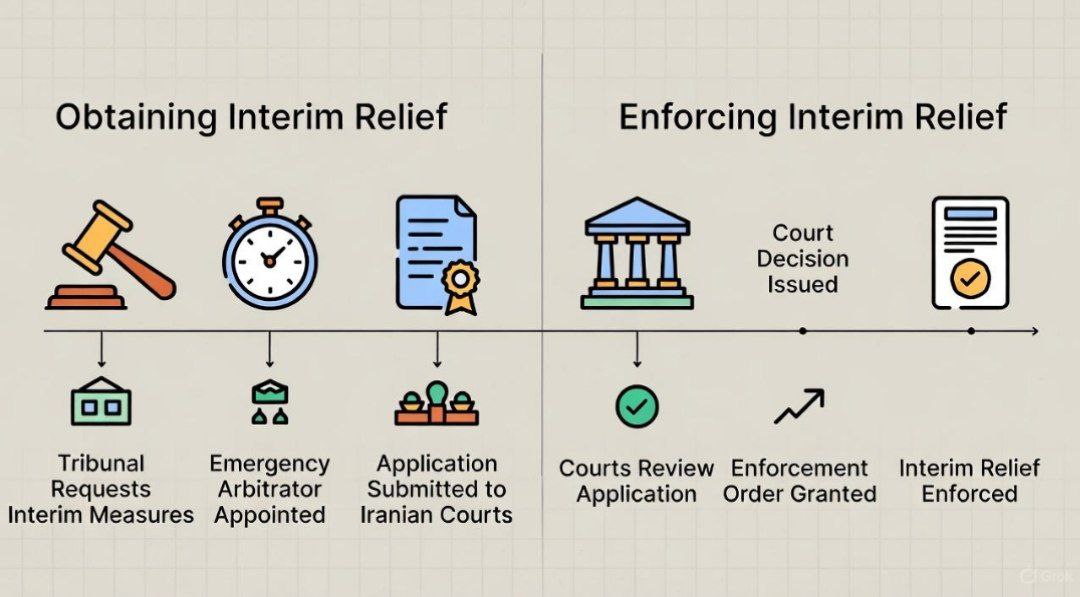
(a) Obtaining interim measures via the arbitral tribunal in Iran
When parties have an arbitration agreement and the arbitration is seated in Iran (under LICA or other applicable law), the arbitral tribunal may have the power to grant interim relief under Article 17 of LICA.
Steps typically include:
- A party makes an application to the tribunal (or institution) for interim relief, setting out urgency, risk of irreparable harm, prima facie case on the merits, and proportionality (though these criteria may be implicit rather than codified).
- The tribunal may grant the interim measure, often subject to security (i.e., bond, guarantee) to protect the respondent from risk of abuse.
- To enforce the order (if the respondent does not comply voluntarily), the party may request assistance of Iranian courts (see below).
(b) Emergency arbitrator route in Iran
Under the TRAC Rules 2018, Appendix 1 outlines a mechanism for Emergency Arbitrators (EAs) in Tehran-seat arbitration, permitting remote hearings for emergency relief.
However, as noted in the commentary:
“There remain, however, open questions as to the enforceability of the decision of an emergency arbitrator, either in the form of an order or an award.”
Thus, while the mechanism exists, its practical effect in terms of enforcement remains untested in many cases.
(c) Enforcement of interim measures via courts
One of the critical issues is enforcement. Even if an interim measure is issued by a tribunal or EA, the real-world effect depends on whether a court will uphold or execute it. In Iran:
- Courts have the power to grant interim measures themselves (especially in domestic arbitrations under the domestic CPC) and assist with the enforcement of tribunal-ordered relief.
- The enforceability of an interim measure issued by an arbitration tribunal may require conversion into a court order or cooperation from the judiciary. The commentary emphasises the “dependence” on court assistance.
- Practical issues: delay, reluctance of courts to enforce an arbitral interim order before the final award, and the lack of a dedicated statutory enforcement route specifically for interim measures (unlike for final awards under LICA/New York Convention).
(d) Common mistakes/risks
Some of the typical pitfalls include:
- Assuming that an interim or emergency arbitrator order will automatically be enforceable in Iran, in reality, enforcement may require court intervention and face delay or resistance.
- Failure to include a robust interim relief clause or to specify the seat and institution to trigger the institutional emergency relief mechanism.
- Relying solely on a foreign-seat arbitration without considering whether assets or parties are within Iran or subject to Iranian court jurisdiction.
- Underestimating the time needed for court assistance: urgency may dissipate, and the relief may lose its point.
- Neglecting to require security or a bond for interim relief may expose the requesting party to indemnity risk if relief is later found to be unjustified.
3. Practical Workarounds and Alternatives
Given the gaps in the enforceability of interim/emergency arbitrator relief in Iran, parties often adopt practical alternatives or adjuncts.
Read more
(a) Selecting a foreign seat (outside Iran)
By placing the seat of arbitration outside Iran, parties may benefit from well-established institutional rules, including emergency arbitrator mechanisms (stronger enforceability) and more reliable court support for execution of interim orders.
However:
- If the respondent is in Iran and assets are in Iran, even a foreign-seat award or interim measure will still require local enforcement in Iran (or seizure of Iranian-based assets), which remains a challenge.
- One must consider local public policy/regulatory constraints on the enforcement of foreign-seat measures in Iran and whether the Iranian court will recognise and assist.
(b) Court injunctions abroad / asset freezes in other jurisdictions
If parties have cross-border assets or operations, they may seek urgent injunctions or freezing orders in jurisdictions outside Iran in parallel with arbitration. Such orders may provide interim relief while the arbitration proceeds. Then, once a final award is obtained (perhaps in Iran or abroad), enforcement may proceed via international recognition (e.g., under the New York Convention).
This strategy increases cost and complexity, but can enhance practical protection.
(c) MJK Law Firm’s approach

At MJK Law Firm, we adopt a proactive and practical approach:
- We advise clients at the contract-drafting stage on selecting a seat, institution, and interim relief mechanism to maximise enforceability in Iran and abroad.
- We assess the asset/jurisdiction profile of the other party and map enforcement risk (domestic Iranian assets vs foreign assets).
- We coordinate in parallel an interim relief strategy: deal with tribunal/EA procedure and engage Iranian courts early for recognition or enforcement steps.
- We prepare for post-award enforcement: whether under LICA (Iran-seat) or under the New York Convention (foreign-seat), and ensure necessary domestic recognition steps are anticipated.
- Gaps and Practical Considerations in Iran
While Iran’s arbitration law provides a basis for interim relief, several gaps remain:
- The concept of an emergency arbitrator is not yet fully embedded in statutory Iranian law (LICA); the TRAC Rules introduce it, but practical enforceability remains uncertain.
- Enforcement of interim measures issued in arbitration may rely on judicial cooperation, and there is no dedicated statutory “fast-track” enforcement mechanism for such orders (unlike final awards under the New York Convention).
- If the other party holds assets in Iran and the relief is granted abroad or under a foreign seat, enforcement in Iran may still require local court action, which adds delay and complexity.
- The urgency element is critical: if interim relief is delayed, it might become ineffective (e.g., assets moved, evidence destroyed). The Iranian court system may not always act with the speed of major arbitration centres.
- Parties must bear the risk of security/guarantee for interim relief; if relief is later found unjustified, the requesting party may face exposure (and Iranian courts may impose indemnity or bond requirements).
- Cultural and institutional experience of Iranian arbitration institutions and courts with modern emergency-arbitrator models remains limited; thus, there is less precedent and predictability.
Nevertheless, many institutions (including TRAC) and commentators see an upward trajectory of recognition of such relief in Iran, which means parties who plan carefully can manage the risk.
FAQ
Q1: Can a tribunal seated in Iran grant interim relief before the tribunal is fully constituted?
A1: Since this mechanism is institutional and not explicitly codified in LICA, its enforceability in each case must be assessed carefully.
Q2: If interim relief is granted by the tribunal in Iran, is it automatically enforceable against the respondent’s assets in Iran?
A2: No. While the tribunal may issue the interim measure, its practical effect depends on the respondent’s willingness to comply and the ability to involve Iranian courts for enforcement. Delay or procedural hurdles may reduce effectiveness. The legal recognition of tribunal-ordered interim relief requires the cooperation of the judiciary.
Q3: Can an interim order issued in a foreign-seated arbitration be enforced in Iran?
A3: In principle, yes, if the parties have chosen a foreign seat and international institution, and the final award is recognised under the New York Convention (to which Iran is party) or through local Iranian recognition of foreign-seat awards. But for interim orders (pre-award relief), enforcement in Iran is more challenging and may require a local court order. The strategy should include concurrent local court action or seat the arbitration where effective enforcement is possible.
Q4: What is the role of security (bond or guarantee) for interim measures in Iran?
A4: A tribunal may require the applicant for interim relief to provide security to protect the respondent from potential harm if it turns out that relief was wrongly granted. In Iran context, parties should include such a requirement in the clause and be prepared that Iranian courts may insist on adequate security when granting or enforcing interim relief.
Q5: What steps should in-house counsel take when negotiating contracts with an Iranian counterparty to ensure effective interim or emergency relief?
A5: Key steps include:
(i) select a seat and institution that provide emergency relief mechanisms;
(ii) include a robust interim/emergency relief clause tailored to Iran-context;
(iii) map the counterparty’s assets and jurisdictions to evaluate enforcement risk (Iran-based assets vs foreign assets);
(iv) engage Iranian and foreign legal counsel early to coordinate tribunal strategy and court enforcement strategy;
(v) consider requiring security/cash flow protections; and
(vi) consider parallel court injunction or freezing order options outside Iran if assets or counterparties are international.
Conclusion
If your business is entering into contractual relationships with Iranian counterparties, or your operation involves assets or disputes in Iran, it is essential to plan for interim and emergency relief before any dispute arises. The team at MJK Law Firm specialises in arbitration and cross-border enforcement involving Iran. Contact our Iranian arbitration counsel today to draft tailored arbitration clauses, assess your enforcement risk, and implement proactive interim relief strategies.