
Legal due diligence on Iranian suppliers means confirming, before you order, that the supplier is a registered entity with an authorised signatory, that it holds the licences and approvals the goods need, that the goods and origin documents are genuine, and that your contract and payment route protect you. Check sanctions rules first.
Foreign buyers sometimes treat checks on Iranian suppliers as a formality, then discover that the exporter was a trading shell, the certificate was inaccurate or the payment route could not be used. This checklist explains what to verify about Iranian suppliers, how to read their documents, which contract terms to insist on and which red flags should stop a deal.
What is legal due diligence on Iranian suppliers, and why does it matter?
Legal due diligence on Iranian suppliers is a structured review of the supplier’s legal status, authority, licences, goods, finances and contract risk before you commit money or place an order. It differs from a commercial reference check because it asks whether Iranian suppliers can lawfully sell and deliver what you want, and whether you can lawfully buy it.
It matters for three reasons:
- Counterparty risk: a supplier that is not what it claims to be cannot be held to the contract you sign.
- Product and documentation risk: exports of goods depend on licences, standards and customs paperwork. Errors can delay shipment or block clearance.
- Compliance risk: your own sanctions position, your bank’s policies and the origin of the goods can matter more than price.
This article is general information and not sanctions advice. Our overview of due diligence in Iran and our guide to trusting a foreign business or businessperson cover related ground.
Can you legally buy from Iranian suppliers at all?
Before any check on Iranian suppliers, confirm whether the transaction is lawful for you. This depends on your nationality, the location of your company and bank, the currency and the goods, and the rules change. Answer this question first, because every other check is wasted if the deal cannot proceed.
Points to settle with sanctions counsel:
- Which regimes apply to you: United States, European Union, United Kingdom and other rules differ. The United States Office of Foreign Assets Control states in its published FAQs that its Iran regulations prohibit virtually all direct or indirect transactions involving Iran by United States persons or with a United States nexus.
- Whether a licence or exemption exists: some categories of goods and services have specific authorisations in some regimes. Do not assume one applies.
- Banking constraints: banks often apply enhanced scrutiny to Iran-related payments and may refuse them even where a transaction is legal.
- Ownership screening: the same published FAQs state that an entity owned 50 percent or more, directly or indirectly, by a blocked person is itself blocked, even if it is not on a list.
If the answer is unclear, stop and take advice before you negotiate further. Only then should you move to the checklist below.
The checklist at a glance
The table summarises the main checks on Iranian suppliers. Each is explained in the sections that follow:
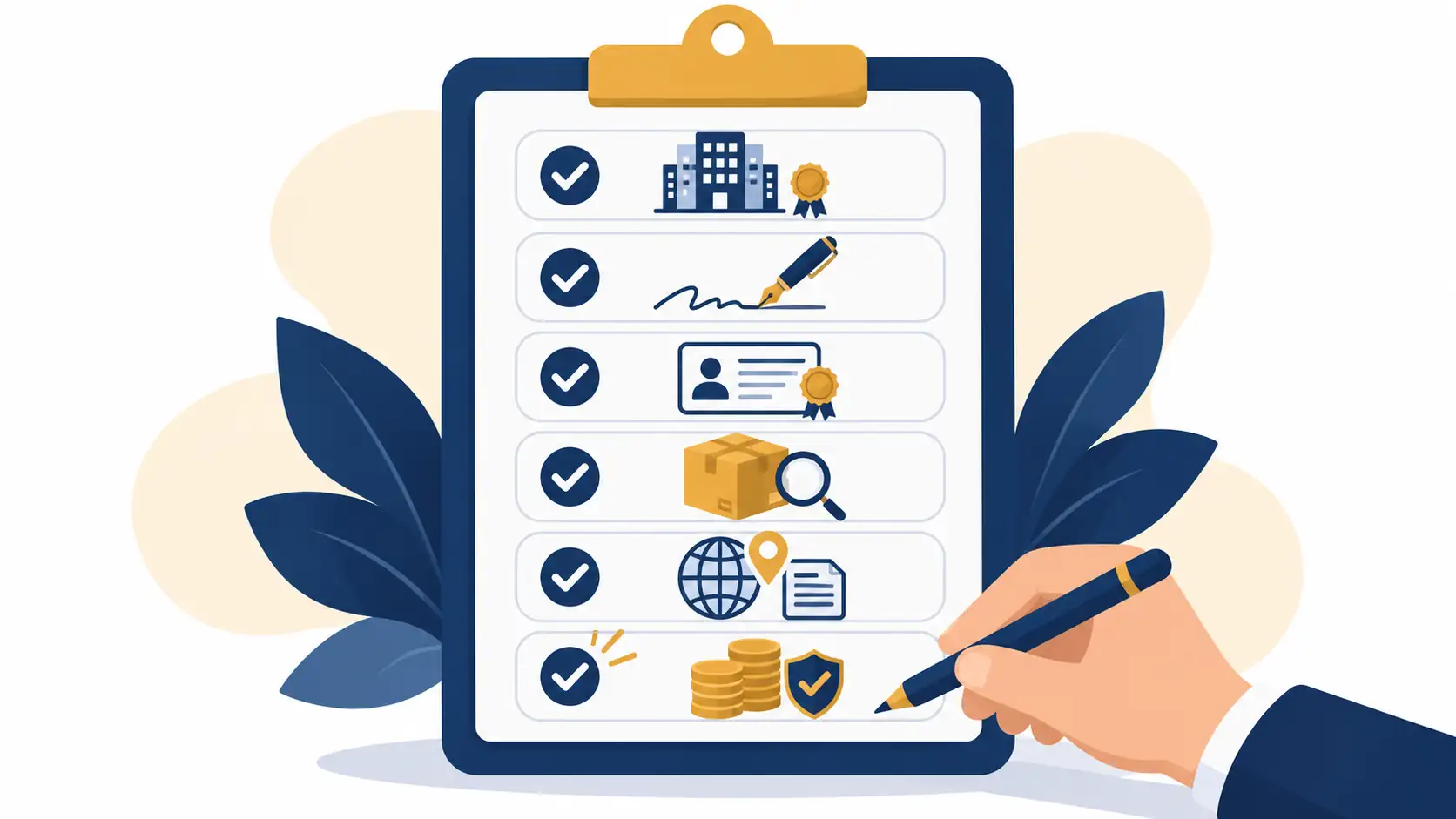
| Area | Key question |
|---|---|
| Legal identity | Is the supplier a registered entity and is the name exact? |
| Authority | Does the signatory have recorded signing authority? |
| Trade licences | Does the supplier hold the licences needed to export these goods? |
| Product compliance | Do the goods meet the required standards and documents? |
| Origin | Is the origin real and the certificate authentic? |
| Finances | Can the supplier perform and what is the payment risk? |
| Contract | Do the terms allocate risk, inspection and remedies? |
| Compliance | Have owners and directors been screened? |
How do you verify the legal identity and authority of Iranian suppliers?
Start with the legal entity. Ask each of the Iranian suppliers you consider for its full legal name, registration number, national identification number of the legal entity, registered address, registered capital and activity. Match these against independent records.
Practitioner commentary describes two public sources. The Official Gazette publishes company registration notices and later resolutions, and a notice typically shows the registration date and number, national ID, subject of activity, address, capital, duration, first directors, authorised signatories and inspectors. The Companies Registration Office also keeps company records, and an online search by company name or registration number is reported to show legal status, registration date, company type and managers. The online system is in Persian and may be hard to reach from abroad, and records can be incomplete or outdated. Ask for certified extracts and confirm them through a local lawyer.
Then check authority:
- Compare the person who will sign with the authorised signatories in the latest registered records.
- If a power of attorney is used, request the original or a certified copy and confirm its scope and validity.
- Make sure the contract names the registered legal entity, not a brand or trading style.
For help reviewing an Iranian supplier’s registration records and signing authority before you place an order, you may wish to contact us at MJK Law Firm.
Which trade licences and export documents should you check?
Iranian suppliers may exist legally but lack the licences to export. Exports of goods usually involve several approvals and documents, and what applies depends on the product.
Sources on Iranian trade regulations describe these common elements:
- Commercial card: persons engaged in foreign trade of goods are generally expected to hold a commercial card issued through the Iran Chamber of Commerce, Industries, Mines and Agriculture and approved by the relevant ministry. Ask for a copy and check that it is valid and matches the supplier’s legal name.
- Export registration: consultancy sources say exporters register in the national electronic trade system using their commercial card and tax details. Ask your adviser to confirm what applies now.
- Customs and shipping documents: a commercial invoice, packing list, certificate of origin and customs declaration are commonly listed. Our guides to the commercial invoice and the bill of lading explain two key documents.
- Product approvals: some goods, such as food, medical products and industrial equipment, are reported to face mandatory standards or conformity certificates. Confirm which approvals your goods require and who issues them.
Iranian suppliers that cannot produce the basic documents promptly should be treated cautiously. For the regulatory background, see our articles on export control regulations in Iran and import requirements in Iran.
How do you verify the goods, their quality and their origin?
Documents say what Iranian suppliers claim. You also need evidence about the goods. Verification should cover specifications, quality control and origin.
- Specifications: attach a precise technical specification to the contract. Vague descriptions create disputes.
- Samples and testing: request pre-production samples and have them tested by an independent laboratory.
- Pre-shipment inspection: appoint an independent inspector to check quantity, quality and packing before shipment. Confirm early that the supplier will allow access.
- Certificates: request certificates of conformity or quality where the goods require them, and confirm authenticity with the issuing body when the value or risk is high.
- Origin: do not accept a certificate of origin at face value. Regulators have warned buyers in other sectors that origin can be disguised or relabelled through third countries, so ask for supporting records such as production, purchase and shipping documents.
- Dual-use and restricted items: banks and authorities may ask whether goods are subject to export controls. Identify this early.
Keep copies of every check. If goods arrive different from the specification, your records support a claim.
What financial and payment risks should you assess?
Even properly licensed Iranian suppliers may fail to deliver if they lack capital or access to inputs. Equally, you may struggle to pay if banks will not process the transaction.
Assess the following:
- Financial strength: ask for recent financial statements and have an accountant review them. Request bank and customer references and speak to them directly.
- Capacity: check production capacity, key equipment and supply chain. A supplier that depends on a single input can be disrupted easily.
- Payment method: commentary notes that Iran’s banking system has limited connections to international networks and banks apply enhanced due diligence, so confirm early how payment would actually be made and what documents your bank requires.
- Letters of credit and guarantees: consider documentary credit or performance guarantees where available. Our guide to letters of credit and UCP 600 explains the framework.
- Prepayment: avoid large advance payments before verification and contractual safeguards.
Where you advance money, protect it with a refund obligation and security, and plan how you would recover it. Our article on asset tracing in Iran explains pre-dispute steps for claimants.
Which contract terms protect a foreign buyer?
Due diligence on Iranian suppliers is only as useful as the contract that records it. Insist on written terms that reflect what you verified:
- Parties and authority: the exact legal name, registration number and signatory authority, with a warranty that the information is accurate.
- Specifications and standards: a detailed specification, quality standard and acceptance procedure.
- Inspection and audit rights: pre-shipment inspection, access to facilities and records, and rights to reject non-conforming goods.
- Delivery and risk: delivery terms, timelines, packaging and the point at which risk passes.
- Price and payment: currency, payment method, milestones and refund obligations.
- Compliance clauses: warranties on ownership, origin and licences, and a right to suspend or terminate if a legal or sanctions risk arises.
- Force majeure: a clear definition and notice rules. See our guide to force majeure in international contracts.
- Termination and remedies: grounds for termination and remedies for non-performance. Our article on terminating a non-performing Iranian distributor illustrates the issues.
- Governing law and dispute resolution: a chosen law and forum or arbitration, with attention to enforcement. Read our guide to the enforcement of foreign judgments and arbitration awards in Iran.
If you buy through intermediaries or agents, address their authority separately. For distribution arrangements, see distribution contracts in Iran.
What red flags should stop a deal with Iranian suppliers?
Some warning signs justify pausing or walking away:
- The supplier refuses to provide registration records or explain its ownership.
- The signatory’s name does not match the registered signatories.
- The supplier insists on large advance payment through an unusual route.
- Certificates or licences look inconsistent, outdated or issued to a different entity.
- The goods, price or origin story changes between conversations.
- A third party, rather than the registered supplier, asks to receive payment.
- The supplier objects to inspection or independent testing.
- Ownership is layered through intermediaries and no one can explain it.
For example, a buyer receives an attractive quotation from a trading company that will deliver from a “partner factory”. If the trading company cannot show a supply agreement with the factory or the factory’s licences, the buyer may be paying for goods that the trader cannot control. Asking early for the factory’s documents would reveal the gap.
Conclusion: legal due diligence on Iranian suppliers
Legal due diligence on Iranian suppliers combines a lawfulness check, verification of the supplier’s identity and authority, review of licences and goods, assessment of finances and payment, and a contract that records the protections you need. No single step is difficult, but skipping one can be costly.
If you plan to buy from an Iranian supplier, you can consult MJK Law Firm for a review of the supplier’s documents and the contract terms to secure. See our services, read our guide to an Iranian lawyer for foreign companies or contact us for an initial discussion.
Key takeaways on Iranian suppliers
- Confirm first that the transaction is lawful for you under the sanctions rules that apply.
- Verify the legal entity and signing authority of Iranian suppliers from registry records and certified documents.
- Check the commercial card, export licences, product approvals and origin documents for the specific goods.
- Test the goods independently and treat certificates of origin with care.
- Reflect your findings in the contract through warranties, inspection rights, compliance clauses and dispute resolution.
Disclaimer: this article is for general information and education, may change as laws and regulations change, and is not a substitute for professional legal advice.
Frequently asked questions about Iranian suppliers
How long does due diligence on Iranian suppliers take?
It varies with the supplier’s cooperation, the value of the order and the complexity of the goods. Basic registry and document checks can be done relatively quickly, while ownership analysis, inspections and sanctions review take longer. Plan the timeline before you commit to delivery dates, and do not shorten checks to meet a deadline.
Can I verify Iranian suppliers online?
Partly. Public records such as the Official Gazette and the Companies Registration Office provide useful information, but the registry system is in Persian, may be hard to reach from abroad and may be incomplete or outdated. Use online searches as a first step, then confirm key documents through a local lawyer or the issuing body.
What documents should I request from Iranian suppliers?
Ask for the latest registration notice, notices of changes, the articles of association, signatory and identity documents, the commercial card, activity licences, product certificates, financial statements and references. For the goods, request specifications, test reports and origin evidence. Confirm important documents directly with issuing bodies.
Is sanctions screening enough to make a purchase safe?
No. Screening is necessary but not sufficient. An entity can be restricted through ownership without being listed, banks apply their own policies and the goods or route may raise separate issues. Take advice from sanctions counsel in your jurisdiction before ordering, and document your analysis.
Do I need a local lawyer to check an Iranian supplier?
A local lawyer helps with Persian records, certified extracts, signing authority and contract terms, and can verify documents with issuing bodies. Sanctions questions need specialist advice in your own jurisdiction. The cost of review is usually small compared with the cost of a failed order.